 A. Definition of Karate
Karate (空 手 道) is a martial art that originated in Japan. This
martial art is little influenced by Chinese martial art Kenpo. Karate was
brought to Japan via Okinawa and began to develop in the Ryukyu Islands. This
martial art was first called "Tote" meaning such as "China
Hand." When karate to Japan, Japanese nationalism at that time was
high-high, so Sensei Gichin Funakoshi changed kanji Okinawa (Tote: China Hand)
in Japanese kanji to 'karate' (empty hand) to be more easily accepted by the
people of Japan. Karate consists of two kanji. the first is 'Kara' 空 and means
'empty'. and the second one, 'te' 手, means 'hand'. Its two kanji together means
"empty hand" 空手 (pinyin: kongshou).
According to Zen-Nippon Karatedo
Renmei / Japan Karatedo Federation (JKF) and the World Karate Federation (WKF),
regarded as the main style of karate, namely:
1. Shotokan
Shoto was the pen name of Gichin Funakoshi,
Kan can be interpreted as building / building - so Shotokan can be translated
as College Funakoshi. Gichin Funakoshi was a pioneer who brought the science of
karate from Okinawa to Japan. Shotokan flow is accumulated and standardization
of various universities in Okinawa karate ever studied by Funakoshi. Adhering
to the concept Ichigeki Hissatsu, ie the movement can kill your opponent.
Shotokan using horses low and parry blows and harsh. Shotokan inclined linear
movement / frontal, so that the practitioner of Shotokan dare to directly
compete and parry blows with an opponent.


2. Goju-Ryu
Goju meaning hard-soft. This flow technique
combines hard and soft techniques, and is one of the colleges of traditional
karate in Okinawa that has a long history. With the increasing popularity of
Karate in Japan (after the entry into Japan Shotokan), Goju style was brought
to Japan by Chojun Miyagi. Miyagi updating many techniques this style into a
style of Goju-ryu is now, so many people who consider Chojun Miyagi the founder
of Goju-ryu. Adhering to the concept that "in a real fight, we should be
able to receive and reply to blow". So that Goju-ryu emphasis on Sanchin
or breathing exercises are basic, so that practitioners can provide a powerful
punch and take a hit from an opponent without getting hurt. Goju-ryu uses parry
that are circular and are happy to do battle within the meeting.

3. Shito-Ryu
Shito-ryu
famous word play skills evidenced by the many words that are taught in the
style of Shito-ryu, which is 30 to 40 words, more than any other stream. But
that is recorded in the headmaster / in Japan there are 111 words along with
bunkainya. For comparison, Shotokan have 25 Wado has 17 Goju has 12 words. In
the fight, Shito-ryu Karate expert can adjust to the conditions, they can fight
like Shotokan frontally, as well as a distance meeting as Goju.
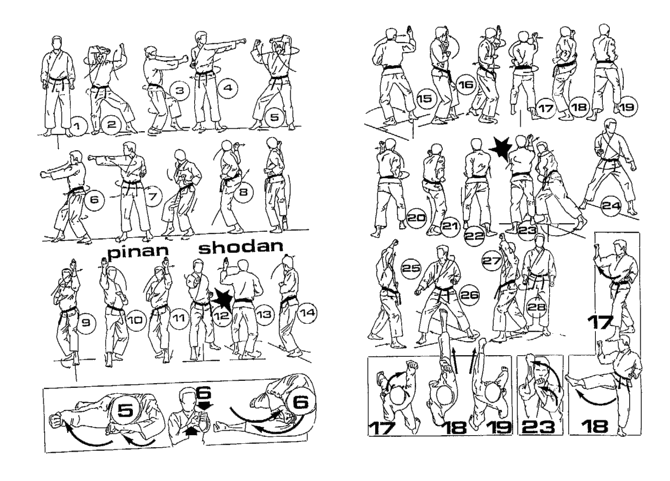 |
| pinan shodan |
 |
| pinan sidan |
 |
| pinan sandan |
4. Wado-Ryu
Wado-ryu Karate is a unique style because it
is rooted in martial art Shindo Yoshin-ryu Jujutsu, a style of Japanese martial
techniques that have joint locks and throws. So Wado-ryu Karate in addition to
teaching techniques are also taught techniques joint locks and throws / dings
Jujutsu. In the battle, expert Wado-ryu Jujutsu uses principles that do not
want to complain frontally power, more use parry that is flowing (not parry
hard), and occasionally using Jujutsu techniques such as dings and leg sweep to
knock the opponent. However, in a game Forki and JKF, Wado-ryu practitioners
are also able to adjust with the existing rules and compete without using moves
such Jujutsu.
The fourth stream is recognized as a
major Karate styles because it participates in the formation of JKF and WKF.
But the style of karate that is
leading in the world not just four styles on top of it all. Several large
streams such as Kyokushin, Shorin-ryu and Uechi-ryu spread to other countries
in the world and is known as the famous Karate flow, although not included in
the "big 4 WKF".
While other large Karate style,
although not included in the "big 4 JKF" include:
1. Kyokushin
Kyokushin
is not included in the four major Japan Karatedo Federation. However, the style
is very well known both inside and outside of Japan, as well as have all
contributed to popularizing Karate in the world, especially in the 1970s. Style
was founded by Sosai Oyama Masutatsu. Kyokushin name has meaning ultimate
truth. This style adopts Budo Karate, where the practitioner-practitioners are
required to dare to do a full-contact kumite, ie without protection, and
attacked frontally, to explore the true meaning of the martial arts of karate
and train the soul / spirit of soldiering (Budo), flow These are often known as
one of the toughest karate school. Unlike most of the style of karate that has
focused on sports, where the game applying the system is not in direct contact
and the results are determined by points, Kyokushin still cling to the
traditional system, seen from the game system kumite championships Kyokushin
applying fight full contact and may make knock Out (KO) opponent. This flow
Hyakunin apply kumite (kumite 100) as the ultimate test, which tested karate
kumite do 100 in a row without losing. Sosai Oyama himself has done kumite 300
people. It is common for practitioners of this genre to perform kumite 5-10
respectively.
2. Shorin-ryu
This style is the flow of the original Karate
came from Okinawa. Founded by Shōshin Nagamine based on the teachings Yasutsune
Anko Itosu, a Karate teacher of the 19th century who was also the teacher of
Gichin Funakoshi, founder of Shotokan Karate. Understandably movement
Shorin-ryu much in common with the Shotokan. A striking difference is that the
Shorin-ryu also teaches a variety of weapons, such as Nunchaku, Kama and
Rokushaku Bo.
3. Uechi-ryu
This style is the style of Karate is the most
widely accepted the influence of Chinese martial arts, because the creators of
this flow, Kanbun Uechi, learn martial directly in Fujian province in China.
Therefore, the movement of the flow of Uechi-ryu Karate Kungfu very similar to
Fujian style, especially Baihequan style (White Crane).
In Japan, an organization that
embodies all of Japan Karate sport is JKF. As an organization that embodies the
whole world is WKF Karate (formerly known as WUKO - World Union of Karate
Organizations). There is also ITKF (International Traditional Karate
Federation) that embodies traditional karate. The function of JKF and WKF
Karate is mainly to confirm that is "no direct contact", in contrast
to the flow of Kyokushin or Daidojuku that "direct contact".
Karate basic training is divided into
three as follows:
1.
Kihon, the
basic motion
Kihon (基本:
き ほ ん, Kihon) Literally means ground or foundation. Kihon Karate practitioners
must master well before studying Kata and Kumite.Kihon training starts from
studying punches and kicks (white belt) and dings (brown belt). On stage or
Black Belt, students considered to have mastered the entire kihon well.

2.
Kata, namely
practice karate moves or flowers.
Kata (型: か
た) literally means the shape or pattern. Said in karate is not only a physical
exercise or regular aerobics. But it also contains a lesson about fighting
principles. Movements Word also contains a lot of philosophies of life. Each
word has a rhythm of movement and different breathing.

3.
Kumite
(Sparring)
Kumite (組 手:
く み て) literally means "meeting of hands". Kumite is done by students
of advanced (blue belt or more). But now, there is a dojo that teaches students
kumite at the beginner level (yellow belt). Before performing free kumite
(Kumite jiyu) practitioners learn arranged kumite (go hon kumite) or (Yakusoku
kumite). Kumite flow for sport, better known as Kumite Shiai or Kumite Match.
Shotokan
in Japan, kumite only by students who have reached the level and the (black
belt). Practitioners are required to be able to keep his punches so as not to
injure comrades compete.
"direct
contact" like Kyokushin Karate practitioners already accustomed to doing
kumite since blue belt strip. Kyokushin practitioner allowed to launch kicks
and blows with all his might towards the opponent to compete.
 Combinations
styles such as Wado-ryu, which technique consists of a combination of Karate
and Jujutsu, then Kumite is divided into two kinds, namely Kumite for the
preparation of Shiai, trained only techniques allowed in the game, and
Goshinjutsu Kumite or Kumite for martial arts, all technique used, including
Jujutsu moves such as dings, locks, and attacking vital points.
Combinations
styles such as Wado-ryu, which technique consists of a combination of Karate
and Jujutsu, then Kumite is divided into two kinds, namely Kumite for the
preparation of Shiai, trained only techniques allowed in the game, and
Goshinjutsu Kumite or Kumite for martial arts, all technique used, including
Jujutsu moves such as dings, locks, and attacking vital points.
In the current era of karate can also
be divided into the traditional flow and flow of sports. Traditional flow more
emphasis on self-defense and combat techniques while exercise more rested flow
techniques for sports events.
B.
Philosophy
 In Karate-Do
Kyohan, Funakoshi quoted from the Heart Sutra , which is prominent in
Shingon Buddhism: "Form is
emptiness, emptiness is form itself" (shiki zokuze kū kū zokuze
shiki). He interpreted the "kara"
of Karate-dō to mean "to purge
oneself of selfish and evil thoughts ... for only with a clear mind and
conscience can the practitioner understand the knowledge which he
receives." Funakoshi believed that one should be "inwardly humble and outwardly gentle." Only by behaving
humbly can one be open to Karate's many lessons. This is done by listening and
being receptive to criticism. He considered courtesy of prime importance. He
said that "Karate is properly
applied only in those rare situations in which one really must either down
another or be downed by him." Funakoshi did not consider it unusual
for a devotee to use Karate in a real physical confrontation no more than
perhaps once in a lifetime. He stated that Karate practitioners must "never be easily drawn into a fight."
It is understood that one blow from a real expert could mean death. It is clear
that those who misuse what they have learned bring dishonor upon themselves. He
promoted the character trait of personal conviction. In "time of grave
public crisis, one must have the courage ... to face a million and one
opponents." He taught that indecisiveness is a weakness.[
In Karate-Do
Kyohan, Funakoshi quoted from the Heart Sutra , which is prominent in
Shingon Buddhism: "Form is
emptiness, emptiness is form itself" (shiki zokuze kū kū zokuze
shiki). He interpreted the "kara"
of Karate-dō to mean "to purge
oneself of selfish and evil thoughts ... for only with a clear mind and
conscience can the practitioner understand the knowledge which he
receives." Funakoshi believed that one should be "inwardly humble and outwardly gentle." Only by behaving
humbly can one be open to Karate's many lessons. This is done by listening and
being receptive to criticism. He considered courtesy of prime importance. He
said that "Karate is properly
applied only in those rare situations in which one really must either down
another or be downed by him." Funakoshi did not consider it unusual
for a devotee to use Karate in a real physical confrontation no more than
perhaps once in a lifetime. He stated that Karate practitioners must "never be easily drawn into a fight."
It is understood that one blow from a real expert could mean death. It is clear
that those who misuse what they have learned bring dishonor upon themselves. He
promoted the character trait of personal conviction. In "time of grave
public crisis, one must have the courage ... to face a million and one
opponents." He taught that indecisiveness is a weakness.[
Philosophy Karate
a) Rakka (Flowers are falling)
This is
the concept of self-defense or defense in karate. Elaboration it is any
defense techniques that need to be done with a powerful and steady, while using
one technique is enough to defend themselves so that likened if the technique
was carried to the top of the tree, then all the flowers of the tree will fall
to fall. For example, if someone attacked by hitting the face, then a karateka
can use techniques to fend off the top. If only parry on it was pretty strong
and steady, the karateka can break that hit the opponent's hand. With that no
longer need to make a follow-up strike was enough to defend him/herself.
b) Mizu No Kokoro (Minda
like water)
This
concept meant that for the purpose of self-defense, Minda (mind) is necessary
to be kept and trained to keep quiet. If Minda quiet, then it's easy to
pengamal martial to dodge or parry the attack. Minda is like water in the lake.
When the float months, we will be able to see the shadow of the moon with the
light on a calm lake. Had dilontar small stones into the lake, the moon
reflecting in the lake will be blurred.
C. The History of Karate
In its current form, karate is less than 200 years old however it has roots that date back thousands of years.
The art originated on the island of Okinawa and in its early form was heavily influenced by ancient Chinese martial arts, collectively known as kung fu.
· The Beginnings of Karate History on Okinawa
The history of Okinawan Karate can be traced back to the late 17th century when a ban on weapons was imposed by the samurai rulers of Japan.
 |
| Kanga Tode Sakugawa |
The exact evolution of karate history is lost due to the lack of information being written down which is unsurprising when taking into account the strict rules against subjects of the island learning martial arts.
This
meant that all training by early masters such as Kanga Tode Sakugawa (pictured)
and Sokon 'Bushi' Matsumura, had to be done in secret and as weapons could not
be carried on the island, self-defence tended to revolve around empty handed
techniques.
The earliest surviving written evidence of karate in Okinawa was a mention of the word Tode (the Okinawan name for the art) in the late 1700s. It was in reference to a visitor to the island from China named Kushanku who taught a form of Kung Fu and may have introduced the first version of the Shotokan kata kanku dai. Tode style blended with the martial arts already being cultivated on the island which was known as Te, meaning ‘hand’.
The was popular in three cities in particular, Shuri, Naha and Tamarai. Each city had its own way of doing the martial arts and modern day styles reflect this; Shotokan and Shito-ryu are mostly influenced by the style from the city of Shuri, that is Shuri-te, and to a lesser extent Tamarai-te. Goju-ryu on the other hand is more influenced by Naha-te.
· Karate History and its Development into a World Martial Art
At the turn of the 20th century, Anko Itosu gained permission to end the shroud of secrecy for those who wanted to learn martial arts and began teaching Te in Okinawan schools. This led to further expansion by one of Itosu’s students, Sensei Gichin Funakoshi, who introduced the art to Japan in 1922.
 |
| Chojun Miyagi Training |
Funakoshi made many modifications to the art to make it more accessible to the Japanese including changing the name and karate as we know it today was born. Towards the end of his life, Funakoshi was instrumental in forming the Japanese Karate Association (JKA) which set about making karate a world martial art by sending out its best instructors to teach it all over the globe.
Today, karate is practiced by millions of people right across the world and although the lines are often blurred between karate history facts and exagerations or legends, the contribution made by the old Okinawan masters and those that followed them should not be forgotten.
D. Ranks /
position in Karate
Rank/ position in karate it is differentiated through the ability
to memorize or perform maximal

o
White belt
o
Yellow belt
o
Orange belt
o
Green belt
o
Blue belt
o
Brown belt
o Red belt
o
Black belt
E. Field Size
·
The floor area of 8 x 8 meters, bare board
or mat on stage with a height of 1 meter and plus the safety area measuring 2
meters on each side.

·
Arena matches should be flat and avoid
potential harm.
In Kumite Shiai used by Forki which refers to the rules of the
WKF, ideally using a mat with a width of 10 x 10 meters. The mat is divided
into three colors: white, red and blue. Matras outermost is the limit jogai
where karate-ka who are playing these limits should not touch or be subject to
infringement. The second limit is deeper than jogai limit is the limit of the warning,
so that karate-ka who are playing can predict space arena he competed.
Remaining scope mat deepest and most with the color white is the arena to
compete effectively.
F. Equipment in karate matches
The necessary equipment in karate matches:
1.
Karate clothing (karategi) for contestants
2.
hand protection
3.
Shin guards
4.
Belt (Obi) for both contestants red / aka and
blue / ao
5.
Other tools are allowed but not a necessity
is:
6.
Protective gum (in some games is a must)
7.
Body armor for contestants daughter
8.
Groin protectors for contestants son
9.
Whistle to the arbitrator / stationery
10.
Uniform referee / judge
11.
Shirt
12.
Gray pants
13.
red tie
14.
Black rubber boots without soles
15.
Scoreboard / n scoring board
16.
administration of the game
17.
red & blue flag for jury
18.
A whistle to referee
19.
Extras: Special to Kyokushin, protective wear
groin protectors for contestants only son. Meanwhile, another patron is not
allowed.


